March 18, 2026
 Read more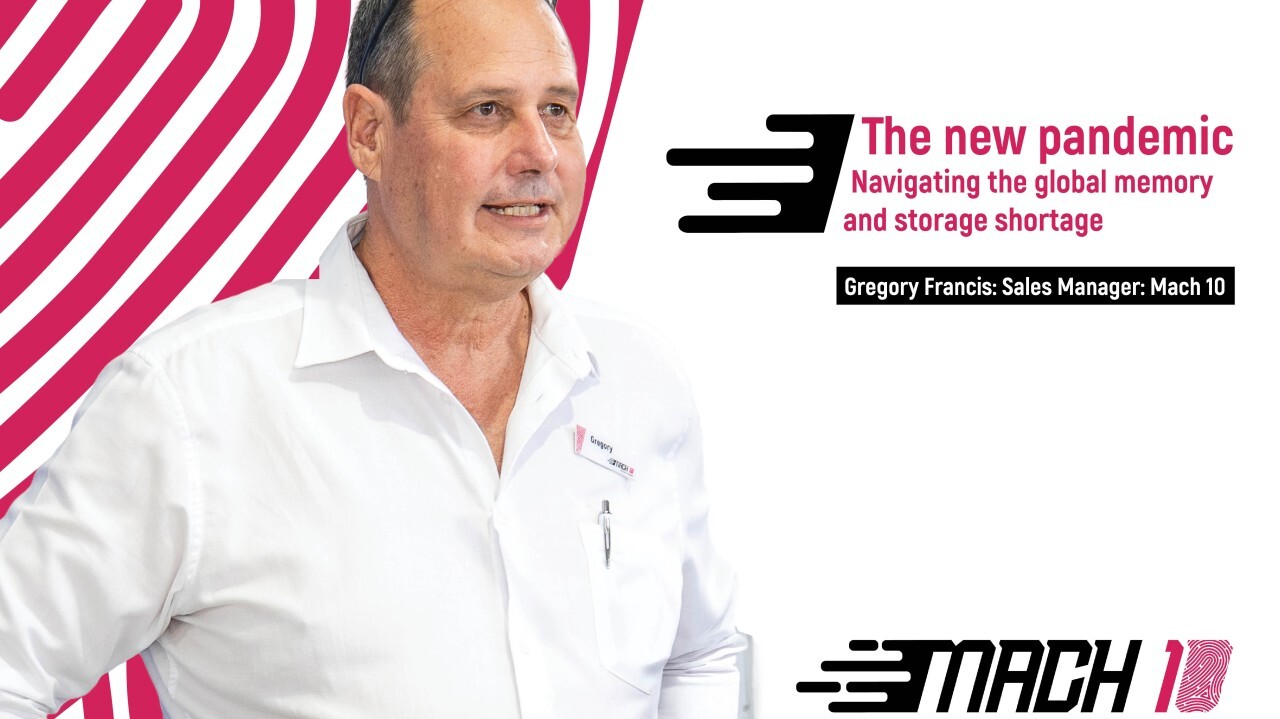
“When we last heard the word 'pandemic' it described something that spread fast, hit hard and caught most organisations unprepared. Today, a different kind of crisis is quietly taking hold — one that does not make front-page news but is already reshaping the cost, availability and timelines of technology across every sector." Gregory Francis has seen it coming. As Sales Manager at Mach 10, an operating company within the O&L Group, he is unequivocal: the global shortage of memory and storage components is not a glitch. For business and technology leaders, understanding what is driving it and acting before the pressure peaks, may be the most important technology decision of 2026.
At the heart of the shortage, Francis explains, is a collision between supply and demand. Global production of DRAM and NAND flash, the two types of memory that power everything from laptops and servers to smartphones and network equipment, is growing at only around 16% to 17% year-on-year. * That sounds reasonable until you understand that demand is surging well beyond those levels, driven almost entirely by one force: artificial intelligence.
AI workloads are extremely hungry for memory. Training and running large AI models requires much more high-performance memory than a conventional server or desktop computer. Hyperscale cloud providers like the Amazons, Googles and Microsofts of the world, are building AI infrastructure at a pace the industry has never seen before. They need high-bandwidth memory (HBM) and DDR5 modules in enormous volumes and they have the purchasing power to secure it directly from manufacturers on long-term agreements.
The knock-on effect is straightforward but serious. Every wafer of silicon that goes into building AI-grade memory is a wafer that cannot be used to produce conventional DRAM or solid-state drives for the rest of the market. Manufacturers, responding rationally to margin and demand signals, are reallocating production capacity towards AI-optimised components. The result? A structural shift in how the world’s semiconductor capacity is deployed, one that may last through the medium term.
For IT and infrastructure leaders, procurement teams and business decision-makers, the practical consequences are already beginning to materialise. Mach 10 is seeing this play out across the market and in conversations with our vendor partners, including HP and Dell Technologies, both of whom have formally communicated supply and pricing pressures to the channel.
It is important to understand that this is not a Mach 10 or Namibia-specific problem. It is an industry-wide structural reality being felt across the globe. What differs is how well-informed and well-positioned different organisations are to navigate it.
The good news is that organisations which act early have meaningful options. The worst outcome is to wait for a shortage to bite before responding. By then, prices are higher, lead times are longer and the most desirable configurations may simply be unavailable.
The highly skilled team at Mach 10 recommends the following practical steps for any organisation planning technology investment in 2026:
Mach 10 continues to work closely with our vendor partners to monitor supply conditions, provide accurate guidance and recommend alternative architectures where appropriate.
“The organisations that will navigate this period most successfully are those that plan ahead, work closely with trusted partners and make decisions based on where the market is going, not where it has been Plan for the future. Partner with Mach 10 today.”